Does emotion work well in business-to-business marketing? Maybe not, many people would say. Making an organizational purchase has different considerations than buying a new shaving cream. And a bad decision for shaving cream may produce minor skin irritation, but a bad decision with third-party vendors could cost someone his job.
So, the thinking traditionally goes, the organization needs information, not emotion. Let's not bother with the larger benefits, just stick to the features -- as in our brochures. Our b-to-b target is an industry veteran who came up through the ranks, likely sales or marketing, so don't try to sell a seller. Play it straight.
That's why retail trade ads look and sound so much the same -- handshakes, puzzle pieces, globes and images of keys unlocking success. That's what seems to work. It may not be glamorous or award-winning creative, but it's effective.
But, though you'd never guess it from trade ads, the b-to-b purchaser has emotions. In a business setting, his emotions are more outward-facing. He's concerned with appearances, even if he'd deny it forever in a focus group or interview. He wants his colleagues to think that he is making rational and informed decisions that will directly benefit bottom-line financials. The key is this: emotion can work in an at-work setting, if the emotions focus on feelings about the benefits accruing to the company.
There is proof by leaders of industry to support our contention.
In 2007, a pair of British ad veterans, Les Binet and Peter Field, looked closely at nearly 900 case studies from IPA Effectiveness Awards over the years. One of the most surprising findings from their study, "Marketing in the Era of Accountability," was the discovery that "Emotionally-based campaigns are not only likely to produce very large business effects but also produce more of them, outperforming rational campaigns on every single business measure."
More recently, according to a CEB/Motista Survey presented at Google's ThinkB2B event last year, emotional connections run deeper for b-to-b clients than business-to-consumer customers. They argued that b-to-b marketing must win over both the horse and its rider, whereas consumer marketing just needs the guy on the horse.
"Between 40% and 70% of customers feel emotionally connected to brands like Oracle, Accenture, FedEx, SAP, and Salesforce," their report continued, "compared with between 10% and 40% for CVS, L'Oreal, and Wal-Mart."
How are b-to-b marketers making these connections? Take UPS for example. Rather than continue to message against their dizzying array of expanded products and services, in their global advertising campaign that launched a few years ago, they opted to own the bigger but simpler idea that: "We (Heart) Logistics." Ads showcasing UPS in action, set to the tune of "That's Amore," were meant to re-frame how consumers and businesses thought about what they did, from delivering packages on-time to a company that swoons for all the little details before, during, and after a delivery.
And though multinational corporations, which traditionally have more resources to develop b-to-b marketing programs that look and feel more b-to-c, there are smaller brands that are using emotion to great effect. Take Acme Brick for example. The Texas-based company decided almost 20 years ago to let builders -- and their end-users -- know that Acme Bricks were guaranteed for 100 years instead of the 3-year industry standard. The majority of its marketing budget is used for image and brand-building activities, including celebrity sponsorships and charity events. Its pitch to architects is as simple today as in its early years: When designing buildings "of consequence," turn to Acme Brick today.
According to an article by Moveo Integrated Branding's Kevin Randall, approximately $20 million of Acme's annual $200 million brick sales is a return on the investment the company makes yearly in brand-building. If a brick can be successfully differentiated, Mr. Randall wrote, then almost anything can be branded to create value.
For those of us in a market or brand research role, let's work harder to help both the agency and marketer side find magnetic truths in what we should remember is still p-to-p marketing -- person to person.
Courtesy Ad Age :By Keith Navratil
Pageviews past week
Sunday, March 30, 2014
Sunday, March 23, 2014
How to Develop an Incentive Program
Well some people don't think that people work better with a little extra motivation or incentive. Well if that is you then you can stop reading.
#1 Establish Objectives
Identify what goal/objective needs to be
accomplished, for example: improved attendance, increased sales of a particular
product, etc. The objectives must be simple, specific, and obtainable. Begin
with a clear, briefly stated objective and communicate it to all participants.
#2 Outline the Strategy
Build the foundation of the Incentive Program
carefully, expanding on the methodology to be used. The structure of the
program should detail exactly who is the target audience, and anyone else who
will be influenced by the program. The size of the group is important to the
budget of the program, as well as the ability to communicate clearly and
measure the results accurately.
Other considerations are geographic boundaries
or sales regions, legal considerations, family issues, the length of the
program and timing, individual goals or team goals, and of course, the reward.
#3 Measure Performance
Define both quantifiable and qualitative goals
that can be measured, and keep it simple. It might be necessary to look at
historical data and come up with an average in order to define a particular
sales goal. The goal needs to be fair to all involved, and obtainable by
everyone.
#4 Establish the Budget
Depending on whether the program involves
sales or non-sales personnel, the budgeting will be different. In general, the
three elements of budgeting include: 1) number of participants, 2) length of
program, 3) expected results.
There are two types of award budgets: 1)
closed-ended, and 2) open-ended. You would need to determine the maximum costs
involved with a closed-ended program, and an estimate of costs involved for an
open-ended program.
In a sales program, the primary rules are: 1)
Anywhere from 5% to 10% of additional (incremental) gross sales during the
incentive period can be applied to the total cost of the program, and 2) The
cost of the incentive awards should equal 5% of all compensation for the
program period.
In a non-sales program, it is more difficult
to put a monetary figure on the value of "improvement," but some
measures are possible that involve increased productivity, improved attendance,
and improved safety (fewer traffic tickets, for instance). The budget is then
determined by the "value" the company will realize from the
improvements made by the Incentive Program.
#5 Budget Elements
|
Awards
|
80%*
|
|
Communication /
Promotion
|
10%**
|
|
Administration
|
5%**
|
|
Training/Research
|
5%**
|
* For merchandise awards, this includes
shipping (about 10% of the cost of the items) and taxes (about 6% of cost).
**The last 3 categories are fixed costs comprising 10-20% of incentive program costs.
#6 Select the Perfect Award
It is important to select the correct award
because if the individual is not emotionally vested in obtaining the incentive
award, he or she will not pursue the goal. Spend some time speaking with the
target group and select an award within the framework of the budget that will be
important to the group.
#7 Administer the Program
Administration is approximately 20% of the
program budget, and a good 50% of the planner's time. The target group needs
clear, consistent communication and timely feedback on measurement of their
performance.
#8 Celebrate the Success of the Program
The end of the program should be celebrated
with the target group and performance measurement by individual or team should
be provided at this point. Individuals should then receive their awards.
#9 Analyze the Success of the Program
Did the Incentive Program achieve its
objectives? Were the participants motivated to change their behavior? Remember,
an Incentive Program provides a short-term gain, and follow-up programs are
important. Start planning the next one today.
Give us a call at 609 807 8856 and have a 30 minute conversation about the merits of an incentive program.
Sunday, March 9, 2014
Dimensional Mail
How
it works:
•Client
Brief- The client was disappointed with the
common marketing response rates of 2% when trying to generate new club members.
Typically it would cost the client in excess of $2,500.00 to get a new member.
A creative, measurable marketing campaign was developed to target a smaller
core list of potential members and to gain a greater response rate.
•Tennis club and to exceed the normal 2% common
response rate. A ten percent response rate was the target or 30 new members.
•Execution
& Strategy: we decided to create a measurable
marketing piece that would generate a greater response than the normal 2%
responses. We gathered the demographic information about the target audience:
targeted area mailed within a 50 mile radius of the club, 50/50 women to men
ratio, median age range between 35 to 55 and generally white collar workers –
and to people that played tennis.
•Overall
Results: the mailer generated an incredible
25% response rate, and generated 75 new members, the measurable program cost
the cub $52.00 net each, a 2,448.00 savings per member.
Direct
Mail ROI Expectation
•Offer
to Spend 50% on AD and 50% of AD
cost on PPDM
•PPDM Budget: $90,000 or $30 per mailing x
3 mailings = $90
•Target 1,000 Businesses
•30% Appt. Rate: 300 Appts.
•30% Proposal Rate: 90 Proposals
•30% Win Rate: 27 Sales at an average
sales of $20,000
•New Sales: $540,000
•ROI: 6:1 First Year
•ROI: 12:1 Second Year
Targeted dimensional mail wins hands down.
Not designed for every company.
If sales people will NOT call after don't spend money.
For those who work it, the programs work
Targeted dimensional mail wins hands down.
Not designed for every company.
If sales people will NOT call after don't spend money.
For those who work it, the programs work
Monday, February 17, 2014
Consumer Reaction: Do Promotional Products Generate Response? (+playlist)
Seven
in 10 consumers recalled receiving at least one promotional product in the past
12
months.
A similar finding was observed in previous studies. Among those who recalled
receiving
promotional products, 70% recalled receiving two or more items
Financial
services, retailers, apparel brands and electronics manufacturers are the most
commonly
recalled advertisers of promotional products. The most often recalled
promotional
product categories include:
1. Wearables (41%): Including Shirts (22%),
Caps/Headwear (11%), Outerwear(6%)
2.
Other Wearables (2%)
3. Writing Instruments (35%)
4. Drinkware (19%)
Promotional
products can be used to minimize time gaps in exposure occasions
and
provide external cues to help brand recall. They should be provided on a
regular
basis, have a clear connection to the brand, and should be relevant to the consumer.
Sunday, February 9, 2014
What is a new client worth? An "A" or "B" level client? How much would you invest to get one?
Now I may be dating myself here, but can you remember the old ice cream bar jingle for Klondike Bars? It went like this: “What would you do for a Klondike Bar?” People would do crazy stunts such as chirp like a bird or make an elephant sound in a crowd of people. Well, when I saw a rerun of that commercial recently, I thought, "What would someone do for a good client?" Or better put: What would someone pay for a good client? When we review our marketing, we are doing just that, investing in the opportunity and possibility of getting a new client, or generating new or existing business. Most people do not know what it costs to get a new client—in fact, most rarely, if ever, analyze their marketing spend to see if it’s viable and cost-effective.
As I consult globally, I am amazed at how ineffective most businesses market themselves. As business owners it is critical that we differentiate and set ourselves apart, because if you are not different, you are the same! Now is the time to seize that opportunity.
This article will be a mathematical analysis of your marketing. You can add or delete zeros at will—the bottom-line is the same. I have used arbitrary figures, but you can plug in your specifics to see the outcome. (These are my numbers when I was a marketing consultant.) Most people today are looking for that Holy Grail idea that will help them get new business, but in today’s market there is nothing cookie cutter that will be effective across the board. Marketing today MUST be strategic and laser focused in order to be effective—that’s the beauty of strategic marketing utilizing promotional marketing—and most importantly, if done correctly, it’s measurable.
So, what exactly is your ideal client worth? What would you spend to get that new client? How much does your best client spend with you on an annual basis? And better yet, what is the profitability, long term, of that client? Take and evaluate your client list and separate them into A, B, C and D categories. Then, place the B, C and D list aside. Take the A list and total the amount of money spent last year with that group, and divide it by the number of clients in that category.
$623,000.00 (total revenue generated) divided by 37 (number of A clients) = $16,837.83
Now what about attrition rate? How long do you keep your average client? In my case it averaged out to be about seven years. What is your average gross profit? For me it was around 54 percent. So let’s do the math.
$16,837.83 x 7 = $117,864.85 projected average run-rate over a seven year period.
Now if my margins run, on average, at 54 percent, then the math looks like this:
$117,864.85 x .54 = $63,647.01 x 37 (A-list clients) = 445,529.13 in profit.
So the question begs itself, what would you pay for an A-list client with the following profile:
In reviewing your marketing it is important to note one critical factor: "Marketing is the deal opener; sales is the deal closer." Too often business owners feel that the marketing should be doing the job of sales—NOT SO! Marketing is the introduction, the teaser. It is the catalyst for people to want to know, see or experience more of what you have to offer—therefore your marketing must be memorable, strategic. It must create a “wow” factor and look to hit emotional triggers that will cause action on the part of the recipient.
Years ago we developed a campaign for a bank. They were targeting local business for commercial accounts and loans. The piece was mailed to 250 potential prospects. After calling the prospects, they were able to secure over 150 appointments with new prospects. Talk about opening the door.
Smart marketers look at their marketing through a series of analytics to determine its effectiveness. To spend $20, $50 or even $100 on an account that can generate $9,091 in annual profits is well worth it.
#brandsuccess and #proprinters can show you how to make this work for you and your company.
As I consult globally, I am amazed at how ineffective most businesses market themselves. As business owners it is critical that we differentiate and set ourselves apart, because if you are not different, you are the same! Now is the time to seize that opportunity.
This article will be a mathematical analysis of your marketing. You can add or delete zeros at will—the bottom-line is the same. I have used arbitrary figures, but you can plug in your specifics to see the outcome. (These are my numbers when I was a marketing consultant.) Most people today are looking for that Holy Grail idea that will help them get new business, but in today’s market there is nothing cookie cutter that will be effective across the board. Marketing today MUST be strategic and laser focused in order to be effective—that’s the beauty of strategic marketing utilizing promotional marketing—and most importantly, if done correctly, it’s measurable.
So, what exactly is your ideal client worth? What would you spend to get that new client? How much does your best client spend with you on an annual basis? And better yet, what is the profitability, long term, of that client? Take and evaluate your client list and separate them into A, B, C and D categories. Then, place the B, C and D list aside. Take the A list and total the amount of money spent last year with that group, and divide it by the number of clients in that category.
$623,000.00 (total revenue generated) divided by 37 (number of A clients) = $16,837.83
Now what about attrition rate? How long do you keep your average client? In my case it averaged out to be about seven years. What is your average gross profit? For me it was around 54 percent. So let’s do the math.
$16,837.83 x 7 = $117,864.85 projected average run-rate over a seven year period.
Now if my margins run, on average, at 54 percent, then the math looks like this:
$117,864.85 x .54 = $63,647.01 x 37 (A-list clients) = 445,529.13 in profit.
So the question begs itself, what would you pay for an A-list client with the following profile:
- $16,837.00 in annual sales
- $9,091.98 in annual profits
- Seven-year attrition rate
- $117,865.00 in projected sales
- $63,647.00 in projected profits
In reviewing your marketing it is important to note one critical factor: "Marketing is the deal opener; sales is the deal closer." Too often business owners feel that the marketing should be doing the job of sales—NOT SO! Marketing is the introduction, the teaser. It is the catalyst for people to want to know, see or experience more of what you have to offer—therefore your marketing must be memorable, strategic. It must create a “wow” factor and look to hit emotional triggers that will cause action on the part of the recipient.
Years ago we developed a campaign for a bank. They were targeting local business for commercial accounts and loans. The piece was mailed to 250 potential prospects. After calling the prospects, they were able to secure over 150 appointments with new prospects. Talk about opening the door.
Smart marketers look at their marketing through a series of analytics to determine its effectiveness. To spend $20, $50 or even $100 on an account that can generate $9,091 in annual profits is well worth it.
#brandsuccess and #proprinters can show you how to make this work for you and your company.
Thursday, January 30, 2014
Trade Show attendance and performance are up is yours?
According to Red Bank, NJ-based Exhibit Surveys Inc., the exhibition industry saw meaningful upticks in 2012, which is a welcome change considering the statistical stagnation experienced in 2011, when the industry held steady but failed to demonstrate any noticeable growth. Each year, the exhibit- and event-research firm polls attendees from more than 30 U.S. trade shows to determine the effectiveness of exhibit marketing and identify industry benchmarks. The company's 2012 Trade Show Trends report includes valuable information about exhibit performance, show-floor traffic, and attendees – their buying power, purchase plans, and attendance habits.
The survey determined that 84 percent of trade show attendees have the power to recommend, specify, and/or make final purchasing decisions. Perhaps more importantly, 49 percent came to 2012 shows with real purchasing intent. While those statistics represent just 3- and 2-percent increases respectively, they compare favorably to long-term industry averages, meaning we may have finally returned to some semblance of business as usual. In fact, 2012's all-show average for Net Buying Influence tied the 10-year high not seen since 2006.
So the question is how do you get these people to stop and visit YOU? Do you target or just set up your booth and "Show up and Throw up"? Come on gang you are better than that.
Put some pre-show planning into it. Who are the best "buyer" "influencers" in your space that could potentially be attending this show? Invite them. Don't wait for the roster to show up and then do something.
Mail to them, email them a promotion but they have to stop by. Make the booth fun, or else if they think they know who you are why would they show up?
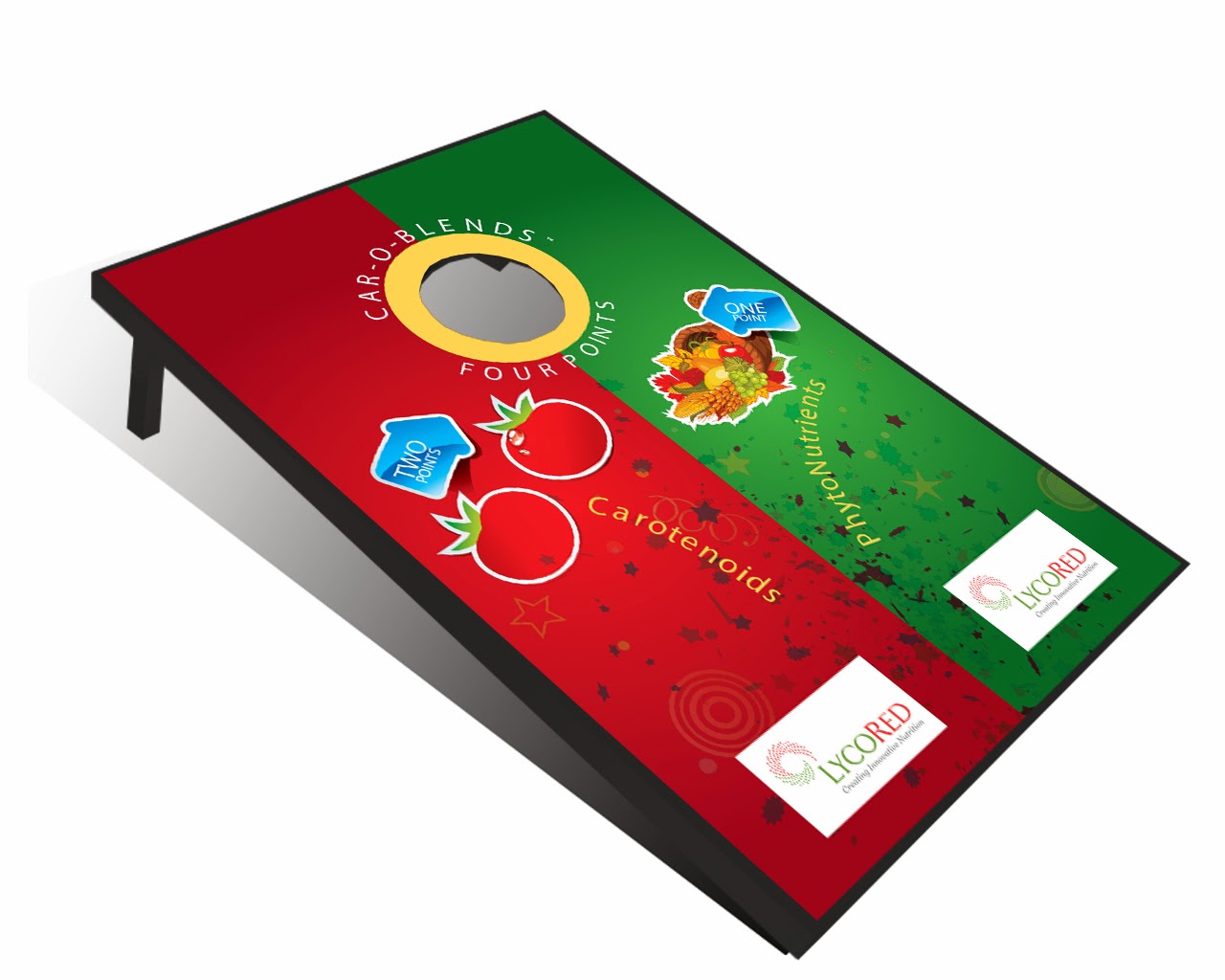
Most recently one of our clients, Lycored, ran a promotion with a custom cornhole contest and the winner got tickets to the Superbowl. Okay yes, was it a nice sized investment on their part. Let us look at the results, and what happened.
Here is an image of the game that people got a chance to play, which we produced the game. Then for showing up you received a promotional football.
No big shakes either. But because of the nature of the promotion our client had John Elway stop by their booth and play cornhole. Yes, the John Elway whose team is in the Superbowl. Talk about great PR, and we have the video link to show you.
But we must create excitement in our booths, if we want to make an impact and attract the right people.
So when you are getting ready to put together a trade show booth, or a pre-show promotion just give us a call and we will drive the non "trick or treaters to your booth"
So here is John Elway himself stopping by my clients boot to play our custom designed Cornhole game. The point is make your booth memorable, and we can help.
Thanks for reading.
Derek
Here is an image of the game that people got a chance to play, which we produced the game. Then for showing up you received a promotional football.
So here is John Elway himself stopping by my clients boot to play our custom designed Cornhole game. The point is make your booth memorable, and we can help.
Thanks for reading.
Derek
Thursday, January 16, 2014
Incentives they work, are you using them?
Many of you are in postitions of sales for your company, and in most cases in a leadership role. Whether you are a branch manager in charge of a sales team, or the president or the CEO of a company.
So you are not directly on the firing lines, but look at the macro ways to motivate your teams to dig deeper and bring in that extra revenue.
Sales people are a competitive bunch, they are aggressive and that is why they have chosen the profession of selling, and as a leader you want to channel that energy and maximize it to reach your revenue goals and objectives.
How can you do that? INCENTIVES!
Take these cards for examples these are a great way to have some fun with your sales team. Each time somebody achieves a sales objective they get one of the cool cards, they scratch them off and win great prizes.
Or you can introduce a points based program similar to an American Express Membership Rewards. Where points accumulate over time for each new account, each new sales, revenue etc.
These points are then redeemed for great prizes from jewelry to stereo equipment and much more.
Some may say "WHAT ABOUT CASH?" Isn't cash king?
Cash satisfies basic needs which does not motivate behavior.
Cash is the currency of compensation and pricing. Use cash and it becomes part of an individual’s compensation package or a customer’s pricing program. Invariably, if you offer a cash incentive to any audience, internal or external, it becomes a benchmark against which future compensation and pricing issues get measured, leading to a condition known as “program addiction.” Because cash quickly gets mingled with other compensation or expenses (in the case of customer cash expenses)
Major Oil Company Study Summary
Non-cash outperformed cash by 46%
Non-cash: 37% increase in product mix
ROI
Cash: -20%
Every $1 invested = an $0.80 return
Non-cash: +31%
Every $1 invested = a $1.31 return
Thank you for reading our blog
Derek Miller
609 807 8856
Subscribe to:
Posts (Atom)